Learning Strategy
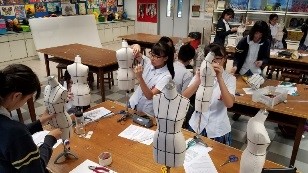
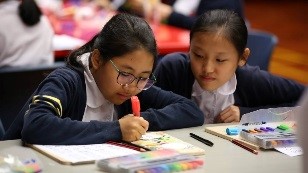
The Visual Arts curriculum is designed to integrate the four basic elements — media and techniques, formal treatment, creative expression, and relevance — while simultaneously cultivating problem-solving skills as well as personal and social abilities. In addition to individual assignments, the curriculum includes group collaboration activities to promote balanced development in artistic creation and interpersonal interaction, embodying the philosophy of whole-person education.
Basic Elements of the Curriculum
- Media and Techniques — “How to Draw”
- Students select and precisely apply appropriate media and techniques to realise the theme. The choice of technique is not only for visual beauty but also to effectively “tell a story”.
- Formal Treatment — “What to Arrange”
- Students master and flexibly apply diverse and precise visual language and design principles to present the theme. Visual elements are like vocabulary, and design principles are like grammar; only when the two complement each other can a good story be told.
- Creative Expression — “What Makes It Different”
- Students demonstrate individuality, uniqueness, and novel imagination, injecting a personal and distinctive perspective into the work’s theme.
- Relevance — “Is It Clearly Expressed?”
- Students integrate elements that fit the theme (such as modelling) to express emotions or ideas at different levels, demonstrating advanced creative ability.
Problem-Solving Ability
For creative tasks, students identify design problems that need to be solved and explore feasible and aesthetically pleasing solutions. In media experimentation, they boldly try different materials and techniques to achieve specific visual effects.
Personal and Social Abilities
- Self-management Ability
- Appropriately allocate time to handle various tasks according to the requirements of different creative projects and complete assignments on schedule.
- Self-learning Ability
- Independently select and conceptualise images, experiment with different media, and gradually construct creations that respond to the theme.
- Collaboration Ability
- In collective creation or exhibition planning, communicate and coordinate with group members, build consensus, and complete projects together.
- Collaboration Ability
-
- In collective creation or exhibition planning, communicate and coordinate with group members, build consensus, and complete projects together.
Specific Assignment Contents by Level
Each level has systematic learning units every school year. Assignments are closely aligned with curriculum objectives and progressively enhance students’ artistic knowledge, creative abilities, and appreciation literacy.
Junior Secondary (S1–S3)
- Classroom Exercises: Worksheets
- Through a progressive learning process, students build classroom learning objectives and consolidate artistic knowledge.
- Unit Tasks: Creation
- In line with diverse creative forms and media, students master the use of various tools and materials, demonstrating appropriate knowledge and skills in artistic form, medium, design, subject matter, and style.
Senior Secondary (S4–S6)
- Artistic Creation
- In response to different creative media, students deepen their ability to use tools and materials, presenting more mature knowledge integration and technical performance in artistic form, medium, design, subject matter, and style.
- Worksheets
- Through a progressive learning process, students build classroom learning objectives and gradually improve their analysis and appreciation abilities.
- Portfolio
- Students are encouraged to conduct in-depth exploration of selected topics. Teachers guide students in developing creations in the form of projects, covering theme understanding, knowledge construction, data organisation and analysis, to final presentation — fully demonstrating the learning process and creative context.